WISE MIND
Have you ever known something logically but felt something completely different?
Maybe you know you’re capable of handling a difficult conversation, but everything in you wants to avoid it. Or you’re angry enough to want to respond immediately, while another part of you knows sending that text right now probably isn’t your best move.
Neither part of you necessarily needs to disappear.
One of my favorite concepts from Dialectical Behavior Therapy (DBT) is Wise Mind, a way of thinking about what happens when we make room for both what we feel and what we know.
Reasonable Mind, Emotion Mind, and Wise Mind
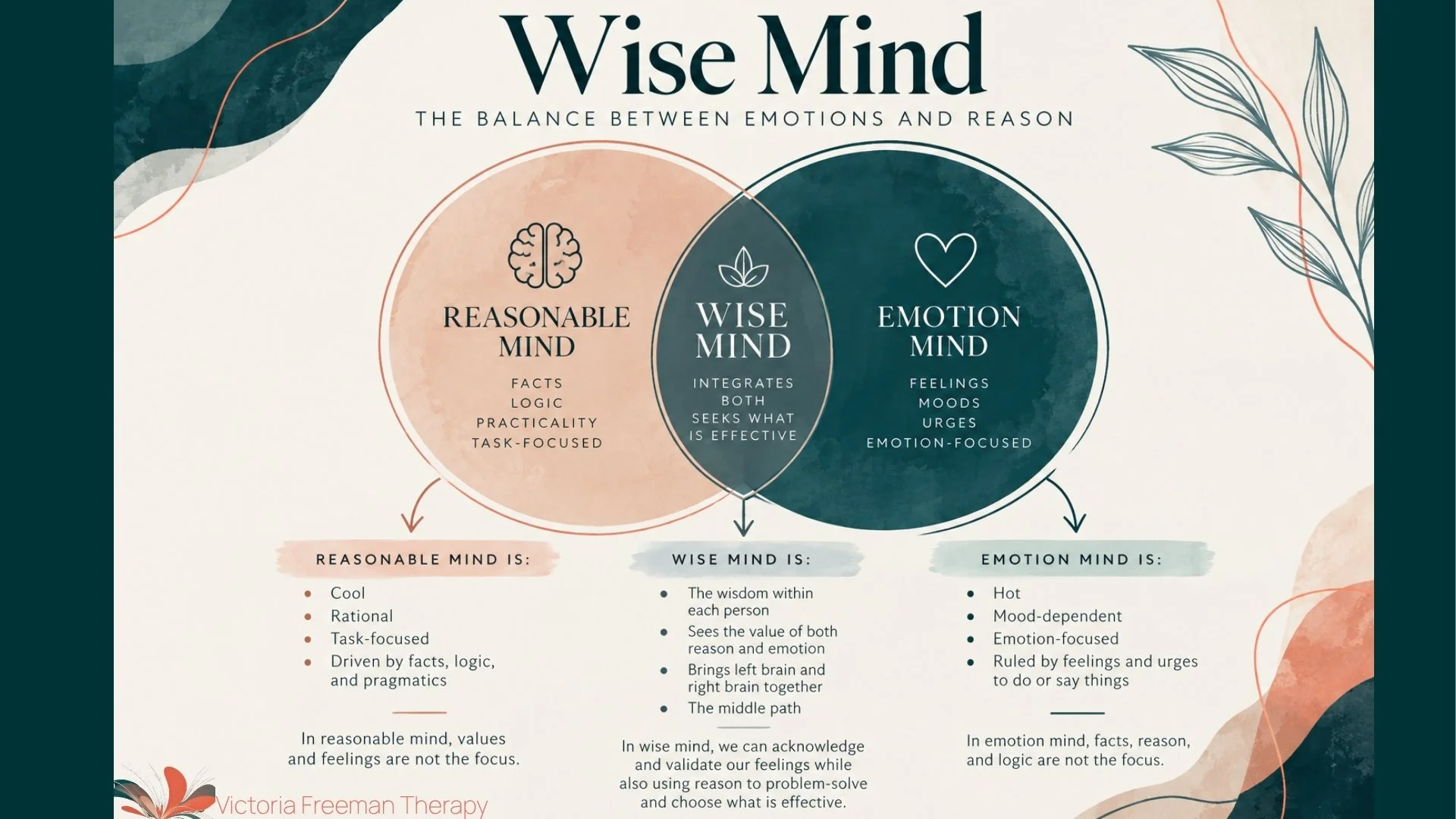
The diagram above shows three states of mind: Reasonable Mind, Emotion Mind, and Wise Mind. Wise Mind sits in the overlap between Reasonable Mind and Emotion Mind.
Reasonable Mind is driven primarily by facts, logic, practicality, and the task in front of you.
It might sound like: “Here are the facts. Here are my options. This is what makes the most sense.”
Emotion Mind is driven more strongly by your feelings, moods, and urges.
It might sound like:
“I don't care what makes sense right now. This is how I feel.”
And then there is Wise Mind.
Wise Mind doesn't ask you to choose between the two. It makes room for both.
Your feelings matter, and so does the information that your reasoning provides.
And then you ask yourself: Knowing what I know and feeling what I feel, what would be effective for me right now?
That middle ground is Wise Mind.
Wise Mind Doesn't Mean Ignoring Your Feelings
Being in Wise Mind doesn't mean Reasonable Mind wins. You aren't trying to logic yourself out of being angry, hurt, scared, disappointed, or overwhelmed.
Your emotions may be telling you something important.
At the same time, having a strong feeling doesn't necessarily mean you have to act on the first urge that comes with it.
Wise Mind gives you room to acknowledge and validate what you're feeling and think about your goals, values, consequences, and what you want to happen next.
Sometimes Wise Mind sounds like: “I'm really angry, and I don't want to have this conversation while I'm this upset.”
Or: “Part of me feels guilty saying no, and I still think no is the right answer.”
Or even: “I don't completely know what to do yet. I need a minute.”
So…How Do You Get Into Wise Mind?
Begin with observing and describing what is happening without immediately judging, adding to, or subtracting from the experience. From there, the next step is choosing how to participate effectively based on what you've noticed.
Notice first. Decide second.
Before immediately reacting, pause and give yourself a chance to notice:
What am I feeling?
What are the facts?
What am I wanting to do right now?
What matters to me here?
What response is most likely to move me toward what I actually want?
You aren't trying to make your emotions go away before you make a decision. You're giving yourself enough room to hear more than one part of yourself before deciding what comes next.
The next time you notice yourself pulled strongly toward either emotion or pure logic, pause before trying to fix anything. Notice what's happening. Name what you're feeling without arguing with yourself about whether you should feel this way or not.
Notice what you know to be true. Then ask: “What is my Wise Mind telling me?”
You may not immediately hear some perfectly clear, profound answer. That's okay. Sometimes accessing Wise Mind begins with simply becoming still enough to listen.
And if slowing everything down enough to hear yourself feels difficult, I created a brief Breathing Wise In, Mind Out video you can follow along with. When you're ready, head to the next post below and practice with me.